
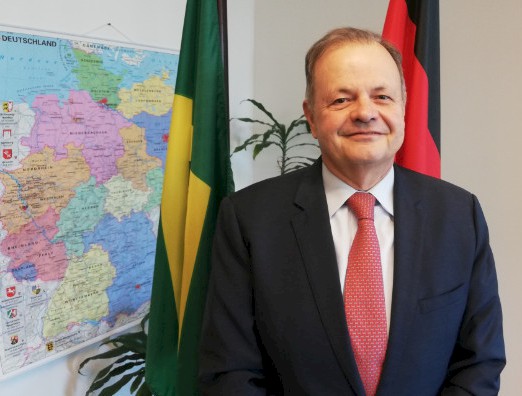
This year, Brazil is the partner country of Hannover Fair, the world’s biggest technology trade fair. What does that mean for Brazil and what is Brazil’s industrial strength? BUSINESS & DIPLOMACY talked to Ambassador Rodrigo de Lima Baena Soares about these topics, about Brazil’s place in a disruptive world and the effect of the EU-Mercosur Free Trade Agreement.
How will Brazil use the opportunity to show its industrial strength at Hannover Fair and in which branches will Brazil put the focus on?
Brazil was the first partner country of Hannover Messe in 1980, which demonstrates how we have a traditional link between our industries. This year offers a special occasion for us, as President Lula will attend the Hannover Messe and meet Chancellor Merz. The president will be accompanied by important persons of the business community - from established companies to startups. We expect a strong participation with more than 150 Brazilian exhibitors, as well as about 300 visiting companies. Our main purpose is to showcase the potential and development of our own industrial sector. The Hannover Messe will show the modern aspects of our industry such as digitalization, automatization, decarbonisation, industry 4.0. Our partnership with Germany is of the utmost importance for the development of our own industrial sector. Thus, many meetings with delegations of both countries will occur, on many different topics.
What are the main pillars of Brazil’s economy?
We have to highlight our potential, particularly in energy. Brazil has a very clean energy matrix with 90 % of our electricity coming from renewable sources. Hydropower is especially important for us, together with solar and wind energy. We also wish to highlight our development in new technologies with startups in many different areas: in agriculture alone, there are 4000 of them. About 20 unicorns are based in Brazil. When one thinks of Brazil, you often have our agriculture in mind, which is quite understandable as we are a powerhouse in this area. We are very proud to feed one billion people, we are number one in many agricultural products. But at the same time we have to turn the view to our industry which is quite complex and modern. You can compare it to that of countries like Germany.
How important will be the role of Brazil’s Green Economy 2030 goals at Hannover Fair?
We have an abundance of clean energy. Brazil is strong in raw materials and infrastructure with a skilled labour force and good human resources. Our aim is to decarbonize our economy. I like to mention our "New Industry Brazil" programme launched in 2024. Its pillars are sustainable agriculture, health and pharmacological sector, infrastructure, housing, digital transformation, decarbonisation and the defence sector. We have to position ourselves as a place for foreign direct investment. We usually count among the top five countries for FDIs. Last year we reached the third place in this rank.
Brazil’s and Latin America’s importance has grown again with respect to raw materials and mining. How will Brazil benefit from this situation?
Raw materials and especially critical minerals are one of our strong points, as we have a good number of reserves especially in rare earths - we are number two in the world. In 2024, Brazil and Germany have signed an important instrument for cooperation, the Joint Declaration of Intent on Extraction and Procession and the Joint Declaration of Critical Minerals Value Chains. We are aiming at producing and exploring in Brazil not in a traditional way of only exporting raw materials. We want to benefit Brazilian companies and add value to the critical minerals in our country. German companies perfectly understand our intentions and objectives in exploring critical minerals and our will to add value in Brazil. Hannover Messe will be another good opportunity to showcase this.
What are Brazil’s expectations in the EU Mercosur Free Trade Agreement and what is Brazil’s view at the concerns of some EU members with respect to agriculture?
This Free Trade Agreement is a major project for both sides and a clear sign to the world that we still believe in multilateralism, especially in times of geopolitical tensions, of unilateralism and growing protectionism. Some media outlets characterized the agreement as “cars for cows”, which is a clear oversimplification. That does not withstand the scrutiny of the agreement’s provisions. Brazil is the number one exporter of beef but we have quotas with 99.000 tons per year of beef and 180.000 tons of poultry. This means 1.5 % of poultry and only 0.9 % of Brazilian beef production and 0.6 % of Mercosur’s total production. These figures show that there is no threat to Europe. Europe itself is the biggest exporter of foodstuff in the world.
When it comes to technical products like machinery and equipment, Europe is an exporter of eight billion Euros. The entire manufacture chain will benefit by importing European components, including the aeronautical sector. This will clearly modernize our industry and will give a technological input to our industry. I am confident that the European Court of Justice will confirm the agreement. The parliament of all four Mercosur countries approved and ratified the agreement. This means a historic success in the relations between the European and Mercosur countries.
What is Brazil’s strategy in foreign trade and economic relations in a disruptive world?
We do not limit ourselves to particular countries or a group of countries. We maintain very diverse partnerships around the world. Our main partners are China, the EU, the US, states in our neighbourhood in South America but also Asian Countries. We have a very diverse portfolio of bilateral trade. It is in line with our universalistic approach to our foreign policy. We talk to everyone: to Asia, to Europe and the US as a very traditional partner. This is our approach to diplomacy. We strive to continue and to promote the diversification of our partnerships as a way to guarantee the independence of our economy. This has helped us a lot in navigating in these turbulent waters. In addition to the EU-Mercosur agreement, we also signed an agreement with Singapore. We have also established negotiations with Canada and with the UAE. In 2025, we concluded negotiations between the Mercosur and the EFTA countries Norway, Switzerland, Iceland and Liechtenstein.
The whole international system is an a profound crisis. We have to talk about how to keep the dialogue and diplomacy in a context of crisis of the international organizations - and not only in terms of peace and security. The UN Security Council needs a reform, an expansion of its membership. That also applies to the economic organizations that we have created after the war like the Bretton Woods system, the IMF and the World Bank. We need a stronger participation of the countries of the Global South. We cannot accept the normalization of force and the weakening of international law.
Is BRICS a helpful alternative?
For us BRICS is a good platform and an important tool for our foreign policy as well as other platforms, such as the G20, CELAC or IBSA.
For our very comprehensive set of interests around the world, BRICS is an important economic platform. It is not a political forum as such. One of the important creations of BRICS was the New Development Bank (NDB) with its headquarters in Shanghai, currently presided by our former president Dilma Rousseff. Brazil has already borrowed six billion US$ from the NDB for infrastructure projects. The BRICS countries operate a vaccine R&D centre what many people are not aware of, and the cooperation among BRICS countries is very well=developed in health, science and technology, as well as among our universities. BRICS is not an anti-West organization. Brazil, a founding member, shares values with western countries.
China has climbed up to Brazil’s and Latin America’s No 1 trading partner and foreign investor. Has Europe and Germany been too reluctant and where do you see assets and opportunities for the German and European business?
China is our largest trading partner but we still manage to have a diversified trade portfolio. Europe and Germany continue to be a major player in the Brazilian economy and trade. Germany has a long history and strong presence in Brazil, with approximately 1000 companies, among them very popular brands, such as Volkswagen, Siemens, Bayer, Bosch - you name it. What we need is an even stronger presence of Germany, which is a key country for us. We need more than exports; we welcome local manufacturing, workforce training, and knowledge transfer. More than 170.000 Brazilians live in Germany and five Million Brazilians are of German origin. There is a very positive perception of Germany in Brazil. We have to take advantage of this. We have to move forward in this partnership.
Interview: Rainer Schubert
2026-03-30
BOTSCHAFTER IN BERLIN
Hier finden Sie alle wichtigen Informationen über die ausländischen Botschaften in Berlin von A wie Afghanistan bis Z wie Zypern. Schauen Sie doch mal rein unter www.botschafter-berlin.de.
MONATSBRIEF
Wenn Sie sich für unseren kostenlosen Monatsbrief anmelden möchten, senden Sie bitte eine Nachricht.
LESER ÜBER UNS
Impressum | Datenschutzerklärung
© Diplomat Media Berlin 2017 —