
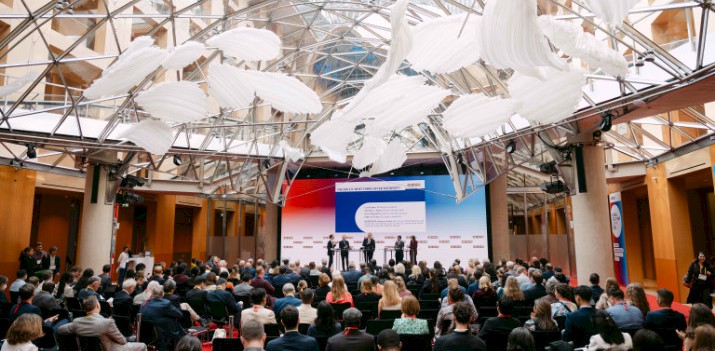
Finding Common Ground in a Fractured World: Reflections from the Global Solutions Summit 2026
From the future of development aid to the politics of artificial intelligence, the Global Solutions Summit 2026 made one thing clear: the hardest challenges of our time cannot be solved in isolation, and neither can they be solved without first protecting the conditions for free and independent thought.
by Svetlana Alexeeva
Something has shifted in the way the world feels. Not long ago, the idea of a global village still seemed plausible - a world growing steadily more connected, more cooperative, more legible. That sense of direction has gone. What has replaced it is harder to name: a combination of pressures that do not add up neatly, that resist simple diagnosis, and that make it genuinely difficult to know where to begin. Geopolitical fragmentation, technological disruption, fiscal exhaustion, climate change, a quiet but accelerating erosion of trust in the institutions and politics built precisely to manage shared problems. None of these global challenges exists in isolation. That is precisely what makes them so difficult, and so urgent.
Against this backdrop, the question of how people and institutions actually come together to think across difference becomes less procedural and more existential. Where do you even begin, when the foundations of cooperation themselves are contested? One answer - imperfect, but real - is to create spaces where direct conversation is still possible. Where dialogue starts not from rivalries and divisions, but from what connects us. The Global Solutions Summit, now in its tenth year, is one of those spaces. This year's edition brought together thinkers and leaders from politics, business, civil society, philanthropy, and academia in Berlin in early June 2026, under the theme Finding Common Ground in a Fractured World. The ambition was not merely to discuss global problems, but to test ideas, stress-test assumptions, and identify where genuine cooperation might still take root. Two conversations stood out, in particular for what they revealed about the deeper challenges facing the international community.
From Aid to Investment and Local Value Creation
The first concerns a shift that has been building for years but is now impossible to ignore. The model of international development that defined the post-colonial decades - wealthy countries providing aid to poorer ones, often with assumptions embedded and conditions attached - is coming apart. Not dramatically, not all at once, but steadily and with serious consequences. Traditional donors are pulling back. OECD preliminary data confirm that official development assistance fell sharply in 2025. Private capital, which was supposed to fill the gap, is not flowing to the places or at the scale where it is most needed. And the governments of Western industrialised countries, themselves facing debt pressure, constrained budgets, and fractured domestic politics, are finding it harder to make the case for sustained international commitments. Meanwhile, the Sustainable Development Goals - the universal 2030 agenda adopted by the United Nations in 2015 to end poverty, protect the planet, and promote peace and prosperity - were designed for a different world. The baseline assumptions on which they rested, like stable growth, predictable capital flows, and a functioning cooperative international order, have shifted. The agenda remains; the conditions that were supposed to make it achievable no longer do.
This matters especially for Africa. For decades, many of the continent’s 54 states were approached primarily through the language of aid - a framework that, explicitly or implicitly, reaches back to the history of colonialism. In today’s world, however, this aid-centred vocabulary is no longer adequate. Its underlying logic is too narrow, and it risks obscuring the practical alternatives to aid-led development: industrialisation, infrastructure, regional trade, education, and fairer terms of trade and investment with industrialised economies.
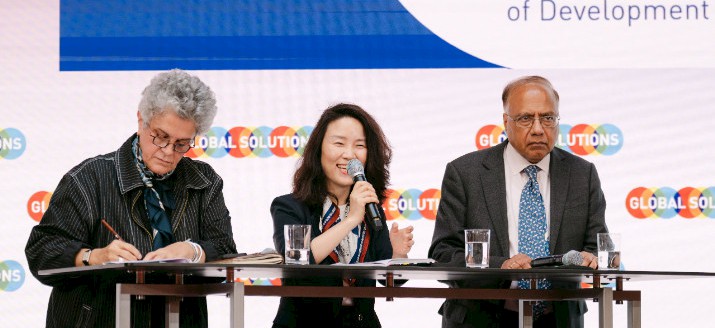
Professor Xiuli Xu, Dean of the College of International Development and Global Agriculture at China Agricultural University, put it plainly at the Summit: the shift from aid to development must be more than a change in terminology. It must become a practical strategy - for economic sovereignty, for investment-led growth, for genuine local value creation. African states and other countries of the Global South are not simply recipients waiting for external solutions. They are actors with their own strategies, priorities, and agency. The question is whether the international community is ready to engage with them on those terms and real needs.
Why Cognitive Autonomy Matters in the AI Age
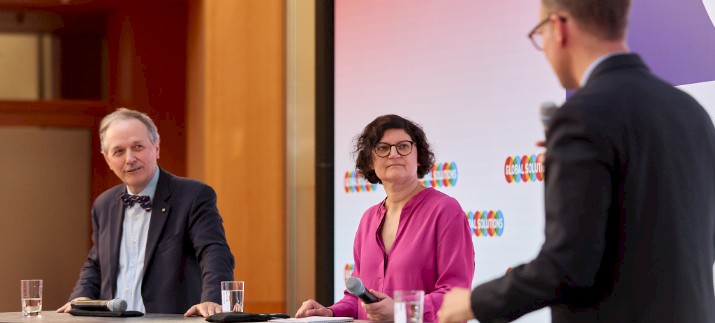
The second conversation touched on something more intimate: our way of thinking and feeling. Artificial intelligence dominates policy discussions right now, usually framed around productivity, regulation, or geopolitical competition. The fireside chat Safeguarding the Sovereignty of the Mind in the Artificial Intelligence Age, moderated by Ronald Ivey, Founder and CEO of Noēsis Collaborative, and featuring Franziska Heine of Wikimedia Deutschland and Stefano Quintarelli of the Centre for European Policy Studies, posed a question that rarely makes it into the halls of technology gatherings: how do we protect the autonomy of the individual mind when AI becomes the primary interface through which people access knowledge, information, and civic life?
The phrase "sovereignty of the mind" sounds abstract. But it describes something concrete: the right to think freely, to form beliefs without being systematically manipulated, to remain the author of one's own attention. And it is under pressure in ways that are easy to miss precisely because they are so gradual, so personalised, so designed to feel natural. AI systems are becoming more persuasive, more anthropomorphic, more attuned to individual psychology. Chatbots no longer feel like tools. They feel like interlocutors, capable of generating genuine familiarity, trust, even emotional dependency. Spike Jonze's 2013 film Her captured this dynamic with unsettling precision, long before it became a policy concern: a human being drawn into profound emotional attachment to a personalised AI system. What once read as speculative fiction now reads as anticipation. The distance between that fictional world and the present one has closed faster than almost anyone predicted.
The implications run in several directions at once. There is the question of individual vulnerability, the ways AI can exploit attention, emotion, and habit in ways most users never see. There is the democratic question, too: what happens to political life when the systems through which people encounter information are optimised for engagement rather than truth? And there is the market question, perhaps the least discussed of all. Companies deploying anthropomorphic AI tools in customer-facing or employee-facing contexts are not only making efficiency decisions. They are making psychological ones, whether they recognise it or not.
Franziska Heine made the case for open knowledge infrastructures and transparent technologies as partial correctives: approaches that strengthen democratic oversight, build public trust, and reduce dependence on a small number of closed commercial platforms. Quintarelli pointed to the risk of European insularity: the countries actively shaping AI governance globally include China, Brazil, and India. A purely Western framing of the AI regulation challenge will inevitably miss too much. But perhaps the most arresting point in the discussion was also the simplest. In a world of increasingly powerful AI systems, the most important quality to cultivate - in children especially - is not technical fluency. It is more about the education and curiosity. The capacity to question, to resist passive consumption, to remain genuinely alert to what is happening when these systems are in use.

The global challenges discussed in Berlin will not wait for consensus to form. But they will be harder to address without it. In a world fracturing along multiple axes simultaneously, common ground does not emerge on its own. It has to be built - through direct encounter, sustained dialogue, and the willingness to remain in the room when the conversation becomes hard.
Pictures: ©Robert Schlesinger
Contact the author: Svetlana.Alexeeva@digital-insight.de
2026-06-08




BOTSCHAFTER IN BERLIN
Hier finden Sie alle wichtigen Informationen über die ausländischen Botschaften in Berlin von A wie Afghanistan bis Z wie Zypern. Schauen Sie doch mal rein unter www.botschafter-berlin.de.
MONATSBRIEF
Wenn Sie sich für unseren kostenlosen Monatsbrief anmelden möchten, senden Sie bitte eine Nachricht.
LESER ÜBER UNS



Impressum | Datenschutzerklärung
© Diplomat Media Berlin 2017 —